
The Insurance Industry and AI
Faster Claims, Better Risk Modeling
12/29/20256 min read
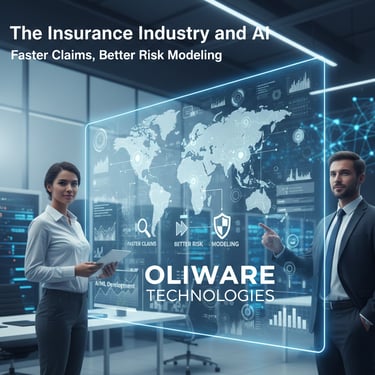
The insurance industry is undergoing a dramatic transformation. As risks become more complex — ranging from climate-driven natural catastrophes to shifting consumer behavior and evolving regulatory demands — insurers must adapt. At the same time, customers expect faster service, transparency, and personalized experiences.
Enter artificial intelligence (AI): by automating manual workflows, augmenting human decisions, and drawing deep insights from data, AI is well positioned to deliver on both sides. And for insurers looking to harness these capabilities quickly and reliably, a partner like Oliware Technologies — with expertise in AI/ML-driven development, generative AI, and enterprise-grade software — can provide the architecture, engineering, and integration needed to turn ambition into operational reality.
In this article, we explore how AI is transforming claims and risk modeling in insurance — and how Oliware can help insurers implement these changes to drive speed, accuracy, and long-term value.
Why AI Makes Sense for Insurance: Key Industry Needs
The Dual Pressure: Complexity & Customer Expectation
Rising complexity of risk: Insurers today face more diverse and volatile risks — from climate events to new liability paradigms, changing property exposures, and evolving personal behavior. Traditional actuarial models and manual underwriting may struggle to keep up in a timely, scalable manner.
Demand for speed and efficiency: Customers often expect quick claim settlements, seamless onboarding, and minimal friction. Manual processing, paperwork, and delays can frustrate them — and raise costs for insurers.
Need for scale and consistency: Insurers handle huge volumes of policies and claims. Ensuring consistent, fair, and accurate processing across cases — regardless of complexity — is a major challenge.
AI addresses these needs by automating routine tasks, holistically analyzing large datasets, and enabling predictive modeling that adapts to dynamic factors.
What AI Brings to the Table
According to industry analyses, AI in insurance delivers improvements including faster claims processing, better fraud detection, predictive analytics for underwriting and risk assessment, enhanced customer experiences, and cost optimization. Multimodal+3IBM+3Cimphony+3
More specifically:
AI-driven document processing and data extraction dramatically reduce manual data entry and errors, speeding up claims and underwriting workflows. Multimodal+1
Consistent, automated rules and predictive models lead to more standardized assessments, reducing human bias and increasing fairness. Cimphony+1
Predictive risk modeling and scenario simulation allow insurers to price policies more accurately and anticipate potential losses — especially useful for property/casualty, climate-related risks, or emerging insurance products. McKinsey & Company+1
Automation of claims verification and intelligent routing — sometimes supported by image- or document-based AI — accelerates claim cycles while improving accuracy. Forbes+2iMark Infotech Pvt. Ltd.+2
Enhanced fraud detection: AI can detect anomalous patterns, inconsistencies, or suspicious activity across massive data, helping prevent false or fraudulent claims. Cimphony+1
Better customer experience: faster processing, clarity, transparency, and even AI-powered customer support (chatbots, self-service, status updates) improve overall satisfaction and reduce friction. Forbes+2NASSCOM Community+2
Given all these benefits, the question is no longer if insurers should adopt AI — but how they can do so effectively, responsibly, and at scale. That’s where Oliware comes in.
How Oliware Helps — From Idea to AI-Driven Insurance Systems
Building Custom AI Solutions — Not “One-Size-Fits-All”
Oliware is not just another generic AI vendor. Its core offering is custom AI/ML-powered application development, designed to match a client’s business model, data infrastructure, and operational requirements. Oliware Technologies+1
For insurers, this means:
Custom claims-processing pipelines: Automatic extraction of data from claims forms, photos, or documents; classification; routing; decision-support; or even end-to-end automation for simple cases.
Tailored risk-modeling and underwriting engines: AI models built or fine-tuned for a specific insurer’s risk profile, historical data, region, and product mix — enabling more accurate pricing and risk assessment than generic models.
Integration with existing systems: Oliware helps integrate AI modules with the insurer’s legacy systems, CRM, policy management platforms, and operational workflows — avoiding disruption while unlocking new capabilities.
Because Oliware emphasizes a “design-first, AI-native” approach, they ensure user-centered workflows, intuitive interfaces, and maintainable architecture combined with powerful AI under the hood. Oliware Technologies+1
Accelerating Claims Processing & Underwriting with AI
One of the biggest time sinks in insurance is claims — from intake to assessment to payout. Oliware can help insurers deploy AI tools that:
Automate data extraction and validation: With AI-driven document parsing, natural language processing (NLP), and possibly computer vision (for photos, damage assessments), insurers can cut down manual data entry and verification time significantly.
Intelligent workflow routing: AI can triage claims by complexity — fast-tracking straightforward ones, flagging suspicious/fraud-risk cases for manual review, and optimizing adjuster assignment.
Faster payouts and customer communication: By reducing manual bottlenecks, insurers can settle claims faster, send automated updates to customers, and deliver better transparency — improving trust and customer satisfaction.
These capabilities — core to many modern “insurtech” transformations — align with the benefits documented across the industry, such as reduced processing time, cost savings, and better customer experience. iMark Infotech Pvt. Ltd.+2Forbes+2
Advanced Risk Modeling & Underwriting with AI — Smarter, More Reliable Pricing
Beyond claims, AI is transforming the underwriting and risk assessment side — a domain critical to long-term profitability and sustainability. Oliware can support insurers by:
Developing predictive models that account for diverse data sources: Using structured historical data, external risk data (e.g., environmental, demographics), and even unstructured data to build multi-factor risk models. These models can identify subtle risk signals that traditional actuarial models might miss.
Scenario simulation and stress-testing: AI-based engines can simulate various “what-if” scenarios (climate events, demographic shifts, economic changes), helping insurers forecast long-term liabilities and adjust pricing or reserves accordingly. This is especially valuable for property, casualty, or emerging-risk insurance lines. McKinsey & Company+1
Dynamic underwriting and personalized policies: With AI, insurers can move toward more usage- or behavior-based insurance models (e.g., pay-as-you-drive, or premium adjustments based on risk indicators). Custom AI systems developed by Oliware can support these flexible, customer-centric offerings.
Fraud Detection, Compliance & Risk Control — Mitigating the Dark Side
Insurance fraud and misrepresentation pose serious risks to insurers. AI can help identify suspicious patterns at scale — and Oliware can build fraud-detection modules with explainability, alerting, and human-in-the-loop review for flagged cases. Oliware Technologies+2Cimphony+2
Moreover, as regulatory scrutiny grows, having AI systems that are transparent, auditable, and compliant becomes critical. Oliware’s strength in building enterprise-grade, custom systems means insurers can embed compliance, data governance, and audit logs from day one — helping them meet regulatory, legal, and internal standards.
Enhancing Customer Experience — More Than Just Back-Office Gains
The gains from AI are not limited to back-office cost savings. With AI-powered customer service (chatbots, virtual assistants), personalized communication, and faster claim resolutions — Oliware can help insurers deliver smoother, more trust-worthy, modern customer journeys. Forbes+2NASSCOM Community+2
This dual advantage — operational efficiency + customer-facing improvements — is often where insurers see the highest return on AI investment.
Considerations & Best Practices — What Insurers Should Watch Out For
While the promise of AI is compelling, deploying AI in insurance also demands careful design and governance. Some important considerations:
Transparency and explainability: Risk models and claim decisions should be explainable — especially when affecting pricing or claim approval. Opaque “black-box” systems may lead to mistrust, regulatory issues, or unfair outcomes. Research warns that overly data-intensive or behavior-based underwriting may lead to discrimination or unfair differentiation. DataToBiz+1
Human-in-the-loop for complex or borderline cases: While AI can handle routine claims or standard risk assessments, human judgment remains essential for complex, ambiguous, or high-value cases. A combined AI + human approach helps balance speed with fairness and accountability.
Data quality, bias mitigation, and model validation: Good AI requires good data. Insurers must ensure their historical and external data is clean, representative, and that models are tested rigorously — especially to avoid bias or unfair profiling. DataToBiz+2McKinsey & Company+2
Integration and scalability: AI systems must integrate smoothly with existing policy-management, claim-management, CRM, and legacy systems — without disrupting operations. This underlines the value of a partner like Oliware who understands system design, architecture, and enterprise needs.
Security, compliance and audit trails: Handling sensitive personal data, claims data, and financial information demands robust security, compliance, and data-governance safeguards built into AI systems from the ground up.
Because Oliware builds custom, enterprise-grade AI solutions, they are well placed to help insurers embed these best practices from the start: designing for explainability, human oversight, modular workflows, and strong integration. Oliware Technologies+2Oliware Technologies+2
Why Now — The Imperative for Insurers to Adopt AI
Multiple trends are converging to make AI adoption in insurance not just attractive — but essential:
Growing volume of claims and data complexity (natural disasters, climate risk, changing asset portfolios, emerging liability risks).
Increasing customer expectation for speed, transparency, and digital-first service — especially among younger and tech-savvy policyholders.
Competitive pressure from “insurtech” players using AI to offer agile, personalized, low-cost insurance products.
Regulatory and compliance landscape demanding better risk management, fraud prevention, auditability, and fairness.
The potential for long-term cost savings and improved profitability — through optimized underwriting, reduced loss ratios, efficient operations, and better risk modeling.
In this context, insurers who delay adoption risk being outpaced by more agile competitors — or being overwhelmed by rising claims complexity and customer dissatisfaction.
By partnering with a seasoned AI-native development firm like Oliware, insurers can move quickly from concept to deployed system — with custom workflows, compliance, scalability, and integration built in.
Conclusion
The insurance industry stands at a crossroads. On one side lie increasing complexity, shifting risks, and rising customer expectations. On the other side lies the promise of AI: speed, scalability, smarter risk modeling, and better customer experiences.
For insurers willing to embrace the future, AI isn’t just a buzzword — it’s a strategic necessity. But realizing that potential requires more than off-the-shelf tools or point solutions. It demands thoughtful design, robust development, trusted integration, and governance.
That’s where Oliware comes in: with its design-first, AI-native approach to building custom enterprise software, it is well positioned to help insurers — whether large incumbents, newer players, or insurtech startups — to deploy AI-driven claims processing, risk modeling, underwriting, fraud detection, customer service, and more. Oliware brings not just technical capability but strategic insight into how AI can transform core insurance operations for the better.
For any insurer looking to make AI a core part of their future, the question isn’t “if” — but “when, and with whom.” Choosing a capable, committed partner like Oliware can make the difference between pilot projects that fizzle and scalable, future-ready systems that deliver lasting value.
Location
Address: Workshaala Vista, N R Tower, 2nd Floor, 17th Cross Road, 19th Main Rd, Sector 4, HSR Layout, Bengaluru, Karnataka 560102
Contacts


Copyright © 2025 by Oliware Technologies Pvt Ltd.